The Gardeners of Earthly Delights
By the time missing US resident Kilmar Abrego Garcia turned up in a hellhole in El Salvador, the story we Westerners had long been telling ourselves could no longer be taken seriously. Perhaps this was the time to ask where that story had come from.
Stories carry cultural riches across generations. The millennia of violent tumult which culminated in the modern West preserved only the faintest traces of the stories which had sustained our deep ancestral cultures. But if ours were like those of unmodernised people still living, they were conduits of wisdom, instruments for locating peace, joy and conviviality in a world where difficulties are inevitable and in the end everyone dies.
Few of the stories we absorb today care to enlighten us in this way. Foolishness, brutality and misery entice us into dark narrative alleys where avoidant fascination with suffering is reinforced. The ‘news’ is largely composed in that vernacular, along with much of our ‘entertainment’, not to assist us but rather to harvest the valuable commodity of our disturbed attention. And stories can also pacify us. If our ability to discern and face the truth degrades, we may, as Hannah Arendt showed, settle for a lie we can live with.
Of course there are many people who know this. And not all of them mean well. Over centuries that knowledge has developed into a dark art, with sophisticated tools, which can steal our allegiances for spurious purposes. And sometimes we may gladly submit, willing to be seduced in exchange for a little extra comfort.
Tension between the difficult truths of mortal existence and the consolations found in reassuring falsehoods is a characteristic of growing up. Maturity requires us to “put away childish things”[1] and practice responsible interdependency with fellow humans and our enormous extended family that forms Earth’s biosphere. But in the modern world, our experience has been remodelled to conceal our interdependent condition, to isolate us and arouse our survival impulses. And the simple reason is that successive generations of rulers have preferred it that way.
Fully developed human adults provide the vehicle through which human culture propagates. But a truly adult social order is inimical to the pursuit of power and money for their own sake. The condition least conducive to despotism is a culture shaped by and for healthy adults, which helps to explain why so many have been erased, and healthy adulthood is becoming vestigial in many places.
Our rulers and the economic systems they preside over can’t provide us with the rich, supportive culture we thrive in. Only such a culture can do that. Many such cultures, including our own ancestral cultures, were at some time overwhelmed by an imposed order of domination and exploitation, the likeness of which we still inhabit. The best it can offer is a cornucopia of substances and experiences which gratify juvenile cravings and palliate distress. And this impairs the ancient epigenetic impetus toward human maturity lived among trustworthy people.
Behind all the little feel-good lies which constitute the modern Western idea of ‘the good life’ is a ‘big’ lie. Whether we realise it or not, we have spent our lives under its pervasive influence. Whatever our personal difficulties or limitations, just being born a Westerner made us part of a ‘superior’ ‘civilisation’, possessed of a formula for living so important and universal we felt authorised, morally obligated no less, to impart it to the rest of the world. ‘Freedom’ and ‘justice’ meant more to us than mere principles; they were ‘brand values’. And yet, Kilmar Abrego Garcia showed us they were as insubstantial as the morning mist.
This was news mostly to Westerners, especially devout ones. People living under Western colonial occupation or in its aftermath had been educated about freedom and justice largely through being deprived of them. Anyone else need only have glanced toward Southwest Asia to see the West’s endless lecturing about human rights and the rule of law made mockery by the mass murder of journalists, doctors, mothers and babies to facilitate another land grab. And there had always been those in the West whose enthusiasm for freedom and justice seemed to vary considerably depending on whether it was theirs or belonged to someone else whose disenfranchisement they preferred.
The atrocity in Palestine was hardly unprecedented; rather it was the latest episode in a project already centuries in the making. If something about it was unusual, it was that this particular genocide was live streamed via the internet; the evidence was therefore hard to miss; yet legacy media soiled themselves defending what ordinary, empathic humans recognised immediately as unconscionable.
The horror show of the West supplying armaments to annihilate civilians, with Western media providing PR, and Western governments suppressing dissent, exposed a methodology which had developed throughout a long chronology of violent conquest in almost every corner of the world. At home much of its viciousness had been concealed or ennobled. Now it was almost impossible to ignore. As the American government sent masked gunmen into peaceful neighbourhoods to abduct law-abiding people, even those who had already looked beneath the lie at some less comfortable truths were startled by the ugly chickens coming home to roost.
What We Learned
The long and short of it was this. ‘Officials’ blamed an ‘administrative error’ for a man’s illegal deportation, which his wife discovered when she saw him on the news in chains with a shaven head. Sensing an affront to their authority, the US Supreme Court unanimously ordered his return. And yet it appeared this wasn’t going to happen.
American residents learned how easily they could be snatched off the street and thrown into prison, without trial, without evidence, without any credible justification at all, actually, but retrieving them, it turned out, could be next to impossible. Even the presidents of both the nations involved, meeting in the Oval Office, expressed in eerie unison their powerlessness to repatriate Garcia. Nor could they help any of the hundreds of others never charged with any offence but locked up in a gulag of such monstrous ingenuity that its sole purpose could only be to slowly torture people to death. Nevertheless, once the press conference was over, apparently feeling their oats again while being ‘accidentally’ recorded, they discussed adding more capacity to the nightmare so American citizens could be thrown in too.
Erik Prince, former CEO of Blackwater, which specialises in extracting profits from mayhem and devastation, often in the wake of US military operations, helpfully suggested that the protective rights of citizenship might be circumvented by designating offshore torture facilities as ‘US territory’[2]. It was left to the Attorney General, sworn protector of the law, to dutifully fabricate some allegations so Kilmar Abrego Garcia could be ‘disappeared’ again. Despite having cleared him three years in a row during the President’s first term, the Orwellian Office of Homeland Security told the press they preferred to keep him locked up anyway[3]. El Salvador’s Vice President let slip the reason they were doing so was Washington was paying them. It transpired there wasn’t anything particularly unusual about it. Profitable mischief isn’t hard to obtain when you can tap the inexhaustible spigot of US public debt to fund it, and especially when you can draw on the vast reserve of US public gullibility to promote it. This is simply ‘American know-how’ for the Twenty-first Century. The prison industrial complex is among its flagship ventures.
Of course Presidents Bush, Obama and Biden had deported millions, but they’d been discrete about it. The conduct of this latest exercise was performative. It reeked of end-of-empire decadence, a faded echo of the crowds baying for blood in the Colosseum or Aztec priests holding aloft still beating human hearts. And it clearly wasn’t a mistake. So many oaths of office can’t be misplaced at once. All that monkey business doesn’t tumble into broadcast unassisted. This was a gaudy multimedia production, slathered in Trump branding. The ‘ship of state’ had been breached and boarded by reality TV showrunners, and justice was once again reduced to spectacle but this time as black comedy. Nevertheless I got the message.
Because the former British colony I was born into had supposedly claimed ‘independence’ long ago, I’d grown up unaware I was still living in an empire. My generation was naïve in this way. We had thought ourselves very clever and free, just as we had been taught. Centuries of colonialism had shown it works better when those among its functionaries who aren’t sociopaths imagine they’re in a different line of business, like ‘development’ or ‘peacekeeping’. With the right school textbooks, cinema and television, there’s much less need for lavish public ceremonies and military parades. The empire had been whispering in my ear my whole life, but I’d mistaken it for the voice of ‘history’ or ‘science’ or ‘western civilisation’. It was noticeable now because it wanted to be noticed. And what I’d learned about the life cycle of empires told me the reason must be that it had entered a new phase.
The study of empires reveals they all employ the same basic method. Empires obtain extra resources from other people and places using violence and intimidation. Those who facilitate this process, wherever they reside, are rewarded, and those in the imperial stronghold where plans are hatched and armies provisioned secure the lion’s share. But once there is no fresh territory vulnerable to conquest, and fewer opportunities for plunder abroad, the upkeep and security of the empire’s extravagant private estates can find no other source than the pillage of the surrounding communities where the rest of us live. Today this is a task for the financial sector, rather than armed militia, but the principle is the same.
The first incursions come as polite announcements: a reduction of services to ‘get spending under control’; tax cuts, deregulation and privatisation to ‘get the economy moving again’. Profits rise and investors applaud but alas hardship spreads, as indeed it must when investors in a diminishingly productive economy demand returns regardless. The resulting decline of general living standards calls forth a series of political challengers promising renewal, and each time hope rekindles, but gradually it becomes clear that circumstances aren’t going to improve no matter who gets elected.
If you thought you were living in a democracy, this evaporation of political agency might be confusing. Our public figures like to advertise the West as ‘open’, ‘tolerant’, ‘fair-minded’ and ‘freedom-loving’. Even now they insist on it, as students have their qualifications revoked for speaking out[4], and militarised police bludgeon people in the street for holding a placard or chanting a slogan[5]. We may somehow contort our minds around the suggestion that kids and grandmothers are ‘attacking our values’, perhaps even ‘threatening national security’. But beneath the soul-sapping rhetoric, in our central nervous systems, the real message registers: “If you don’t comply we will harm you.”
What could have changed? Repression is something ‘our enemies’ do, especially those ‘backward’ and ‘dangerous’ countries run by ‘terrorists’ and ‘dictators’, who often hoard the natural resources our corporations want, and whose education in ‘Western values’ sometimes requires the deployment of armed forces. We, on the other hand, are ‘the good guys’, living in ‘the free world’, our rights to free speech and public protest sacrosanct. How then do we explain British protesters[6] and Australian whistle-blowers[7] risking long prison sentences while an American President sends marines to crush dissent in American cities[8]?
The West’s ‘big’ lie masked the rapaciousness and cruelty of its operating system. For good fortune to depend on the suffering of others was anathema to most people. The lie took care of that. It hid the worst injustices, and proffered rationalizations for those still visible, the recurring theme of which was a hierarchy of human worth. God, or his HR-recruited successor ‘natural selection’, had apparently graded humankind according to class, race and gender, awarding opulence and indolence at the top, and sacrifice, obedience and forbearance at the bottom. Imperialism kept a side door open for ambition (while paying off mendacity and ruthlessness at the tradesman’s entrance) but whichever system for winnowing the wheat from the chaff prevailed, if too many hopes and dreams ended up among the chaff, insurrection threatened; and whenever the lower orders insisted on a bigger share of the booty, more of the exploitation which produced it, and the devastation which resulted, needed to be outsourced to people and places at a distance.
The ‘way of life’ we came to think of as a cultural birthright was reward for complicity in plunder. Now that imperial expansion had stalled, stymied by self-inflicted wounds and new geopolitical rivals, we found ourselves stalked by the same predatory forces formerly reserved for the ‘Global South’. The crowning achievement of ‘globalisation’ wasn’t the spread of Western democracy after all, but rather its torture and execution in our own public square.
Although it may have seemed to happen overnight, this transition had taken decades; few of us had noticed at the time; too late we recognised the steepness of our slope; and by then we had no means to curb the mad careening; although we still made hopeful offerings to Mammon, it gradually dawned on us that Mammon wasn’t listening anymore; our rulers, on the other hand, by this time patched into our central nervous systems through our handheld devices, detected our wavering commitment; such threats to the perpetuation of elite rapine could not be overlooked; and from then on civilisation itself was on the list of unaffordable luxuries.
We had expected barbarians outside the gate, not among us. But in fact they’d been there all along, wearing the trappings of civilisation without really accepting its precepts. This was no recent development. To understand how it emerged we need to look back almost as far as we can see.
The Mythos of the West
Milton Friedman, who preached the neoliberalism which descended on the modern West like a flock of harpies, observed that during a crisis, actions taken depend on the ideas which are “lying around”. His advice for those pursuing change was to develop policy alternatives in readiness. But an alternative is only persuasive when it fits our vision of who we are and how things work. Shaping the dominant paradigm was also necessary. And some of the ideas most useful to that project had been “lying around” for a very long time.
The feature which made these ideas so different from those which had come before them was they were written. People long dead, from vanished ancient cultures, had encoded abstract conceptions of the world and the place of humans in it into texts composed from symbols; and these had circulated and accumulated in libraries and private collections, comingling and transmogrifying with each copy or translation, lending grand themes and the gravity of their antiquity to an architecture of influence fashioned out of fossilised thought.
Ideas shared through an embodied exchange are received differently from those which arrive in a medium of record such as writing. Any experienced salesperson knows that the setting and circumstances of the spoken word, the status, appearance and behaviour of the speaker, and the presence and responses of others convey much of the meaning we take away with us. In this way, speech has more in common with other social behaviours than with the written word.
Written language arrives as visual symbols; we decode its messages in a walled garden of attention, at the pace of our own cognition; and unlike speech, which we learn just by living with others, reading requires schooling, and this makes it amenable to curation by aloof authority. Writing presents ‘truth’ as a material product which can be standardised, replicated, disseminated and, if necessary, enforced; such 'truths' can be combined to build a worldview; and if this is formalised as organised religion or the law, a new class of administrator is called into being whose concern is neither its authenticity nor its efficacy, but rather our adherence to its letter.
Writing facilitates the expansion and perpetuation of rulership. This is how it was conceived, as ancient rulers and their priests concretised the obligations of their subjects on Sumerian clay tablets and Egyptian papyrus. Of course, whenever enough human beings get their hands on such a powerful tool, some of them will make art with it, and some will do business. Writing developed into a many-headed beast; precisely factual; compellingly false; bearing through time and space esoteric principles, malicious lies, technical minutiae, and eventually rallying cries for revolution, but writing proliferated first as a tool of coercion and control; the codes of Ur-Nammu and Hammurabi, the ancient precursors of modern legal systems, concretised each ruler’s will throughout his realm, transmitting also the threat of consequences for infringement and dissent. This much of our intelligence was 'artificial' long before a microprocessor ever went to work on it.
The language of control now suffuses the interwoven hierarchical networks that run the Western world like an ivy league hand in a Fortune 500 glove. Public speech, from advertising to the nightly news, reinforces it. Our ‘history’, ‘science’ and ‘entertainment’, however impartial we may perceive them to be, are fashioned from the urtexts of elite rule.
Writing is only recent in human evolution, coinciding with the rise of city states and agrarian empires; so it isn’t hard to see a corresponding change in our shared cognition from a process which is inherently relational and participatory to one where rigid ideas can be imposed at a distance. For this purpose, conquerors trailed retinues of scribes and bookkeepers. Palaces, temples and military might could awe a populace, but stability required the formalising of roles, obligations and entitlements, while it took a righteous tale to imbue them with a sense of destiny and permanence. And the setting for the appearance of the artefacts which recorded this is the change in humankind’s understanding of ourselves and our place in the world which accompanied a revolutionary new way of life.
Agriculture
Domestication of plants and animals preceded the development of writing by many thousands of years. Nevertheless, insight can be gleaned from physical remains, and the oral stories of the transition were among the first to be written down.
Early attempts at cultivation were supplementary, but wherever these new skills took hold, albeit ever so slowly, they became transformative. At the cusp of the Neolithic, at Göbekli Tepe[9] in modern-day Anatolia, there were experiments with wild cereals. The people of Jericho[10] in what is now Palestine’s West Bank left stone walls and evidence of grain storage. It took roughly another thousand years for nearby Çayönü[11] and Nevalı Çori[12] to demonstrate domestication of plants and animals. And several millennia more had to elapse before the Cucuteni–Trypillia[13] culture of today’s Eastern Europe left evidence of mixed farming, herding, hunting, and gathering. By then, people had congregated in settlements of many thousands, without centralized authority, organised instead as egalitarian communities of households.
People still live this way in secluded corners of the world. And nostalgia for it is in the blood of many others. Like wilderness tourism, back-to-nature movements are common in modern, technologically insulated societies. 7,000 years ago, 'primitive' settlements were the height of cosmopolitanism. But humans were unprepared for the new potentials they unlocked.
The visionary writer Daniel Quinn detected warning messages in the Book of Genesis in the Old Testament[14]. The story of ‘the fall’ augurs of the dangers of attempting to manipulate the natural world. A ‘forbidden fruit’ bestows a god-like power to judge what is ‘good’ or worthy of protection, and what is ‘evil’ or suitable for destruction. The price for claiming this knowledge is banishment from ‘the garden’, destining Adam to a life of labour and Eve to constant childbearing.
The transition to settled agriculture largely vindicated this prognostication. Even today, hard work and big families are the usual ways poor farming communities stay fed and housed and relatively safe. But there were graver consequences.
Agriculture made possible a new prescription for living. Wherever it was adopted, people moved from the forests, hills and valleys they had shared for millennia with weather and wild animals into built environments which contained mostly just themselves and their livestock, pests and parasites. The evolutionary forces which had shaped them were kept at increasing distance. Origin stories such as Genesis wove metaphysical explanations into their language and thought. They would come to conceive of themselves as separate, superior and special. They would become fixated on remodelling the biosphere to suit their preferences. Eventually whole lifetimes would be spent in giant habitable machines converting life on Earth into products for hedonic consumption. Humankind would not reawaken from the dream of supremacy before it had caused an ecological crisis at planetary scale.
And Let Them Have Dominion
Scholars generally agree that the stories in the Book of Genesis bear little relation to the rest of the Old Testament. Most likely they pre-existed Judaism, handed down among the Semitic pastoralists who lived adjacent to the ‘fertile crescent’ where agriculture first flourished. Merging with the written record may have altered them; but their essential themes seem to have endured.
Pastoralism and intensive cultivation aren’t compatible on common land; one must prevail at the other’s expense. In the story of the brothers Cain and Abel, Abel’s sacrifice from his flocks is welcome, whereas Cain’s offering of farming produce is not, whereupon the resentful Cain murders his brother. Raising crops, we might infer, spells trouble for nearby pastoralists, and again this forewarning proved accurate.
Pastoral animal population numbers, like wild ones, fluctuate with cycles of attrition and replenishment of habitat. Settled agriculture, on the other hand, demands a fixed tribute from land held captive. Dependence on a limited range of domesticated plants exposes food sufficiency to extrinsic threats; an especially cold winter, a drought, encroachment by neighbours; these or other disruptors gradually shift the general disposition of occupation from shared custodianship toward exclusive possession. ‘Private property’, which would become one of John Locke’s trinity of ‘Enlightenment’ values, has little meaning for people living in a dynamic continuum of reciprocal relationships. But once it exists, it must be protected.
Among unmodernised peoples there is commonly a taboo against knowing or owning too much. It helps to immunise communities against sociopathy. And it encourages intertribal relations built on peaceful coexistence. Status in these communities is typically a function of contribution rather than acquisition. If that changes, and individuals or groups ascend to power through surplus accumulation, military prowess or by invoking supernatural forces, the safety and abundance maintained through mutuality may be reimagined as spoils of war or perks of office.
Violence among humans is a legacy of our primate ancestry, but occasional conflict over natural food sources and breeding partners is very different from a pitch battle for survival or territory. The appearance of massacre sites among the early farming communities of Europe and West Asia from about 7,000 years ago records the beginnings of a trend in this direction[15]. By the time the old stories were written down, settled agriculture had spread across much of the region, bringing with it an epochal change in the way human communities were typically organised.
From Farm to Empire
Sites at the Tollense Valley [16] and Megiddo [17] mark the shift during the second millennium BCE from sporadic violence to organized warfare involving strategy and logistics. By this time, small-scale mixed cultivation for local consumption had developed into large-scale farming of staples to produce a fungible surplus. Harvested grains had created a store of solar energy which could be traded with neighbours or deployed to feed a construction workforce or an army. Powerful tribes had used it to expand zones of influence beyond city states such as Eridu, Uruk, and Ur in Mesopotamia into the much larger agglomerations of territories and peoples like Akkad, Assyria and Babylon which we call ‘empires’.
The earliest writing reveals that religion and finance were entwined with statehood from the beginning. The temples and royal palaces which stored grain also kept silver and other valuable trade goods, issuing loans to farmers and merchants, often with interest, which they recorded on clay tablets. Merchants also provided money‑changing and credit in a prototypical form of private banking. Later attempts to eject moneylenders from the temple and to get big money out of politics would meet with limited success; by then these arrangements had been in place a long time.
Around 1200 BCE, three of these empires – Mycenaean Greece, the Hittites in what was to become Turkey and Syria, and the New Kingdom of Egypt – simultaneously entered a period of rapid decline. Evidence suggests a sudden drop in agricultural production was triggered by a regional climatic upheaval[18].
The dangers of relying on restricted food sources and extended trade routes were made manifest. Storehouses emptied; starvation arose; centralised authority fractured; disorder and mass migration weakened once prosperous towns; the trade in copper, tin and wood which underpinned the Bronze Age dwindled. Communities across the region fell back on earlier ways of living preserved in cultural memory. Some populations near the coasts succumbed to ‘Sea Peoples’, a story told in ruined cities, new styles of pottery, and DNA which, in a foretaste of our own epoch, came from Europe with superior ships and weapons.[19].
In the 2020s, a ‘pandemic’ reminded us how many risks are global now, with mega corporations and their hostage institutions top among them. Such crises get us talking again, and afterwards it’s tempting to imagine we have come together and learned something. But that would be illusion. What we are typically left with is a new layer of unhealed collective trauma, which our rulers, having learned more about us than we of them, are well placed to exploit to deceive and divide us. Living in an empire, right up until collapse, harmful arrangements are as likely to last as helpful ones if they reinforce the status quo. In ancient agrarian examples, as in modern technological ones, the status quo embodied a principle unfamiliar to hunter-gatherers and early farmers.
The Hierarchy of Dominance
The populous proto-city of Çatalhöyük[20] in what today is central Turkey appears to have been egalitarian, matrilineal and matrilocal, with women prominent in ritual, kinship and household. A proliferation of female figurines demonstrates the centrality of fertility and domesticity in this as in other early agricultural societies[21]. By the Bronze Age this had changed.
The physical demands of large-scale farming, construction and warfare had placed a premium on upper body strength and fighting skills. Bit by bit, in the places where this way of life had taken hold, women had been relegated to supportive status – birthing, nursing, and caring preferentially for the males who were more available for heavy labour and soldiering. Early city states had embellished the productive regimen with a ‘slave’ class of captives from conflict.
Although history denies us a neuroscientific ‘smoking gun’, for Ian McGilchrist[22] the reordering of culture around agricultural productivity, empire building, and bureaucratic administration self-evidently reinforced left-brain bias. The contextual and relational right-brain awareness which could have moderated these trends through traditional cultural practices was overshadowed by a new and powerful collective impetus to consolidate control with force. In the archaeological evidence of this region and period, early Neolithic female figurines yield to symbols of masculine warrior culture. And if might was right, bigger was better.
After centuries of disintegration, remnants of the earlier empires were absorbed into an extensive new empire under Cyrus the Great of Persia, and along with them various local innovations in organising at scale. Official languages, minted currency and taxation linked subject peoples economically; policies of cultural and religious tolerance strengthened social cohesion; irrigation canals, roads, ports, aqueducts, drainage systems, public buildings and a postal service supported large concentrations of population; professional armed forces and a civil service maintained security and order; recently domesticated horses provided extra muscle power.
Although most of humankind still lived in nomadic tribes or small villages, the Achaemenid Empire became the template for the material and cultural characteristics of what we commonly refer to as ‘civilisation’. And along with it came the dogmatising of certain ideas which had only recently appeared.
The March of Progress
In the modern West, even after two World Wars and a Great Depression, the idea that human life is defined by ‘progress’ had somehow lived on. Many who saw the illustration Rudolph Zallinger made for the Life Nature Library of hominids evolving into ‘modern man’ might’ve recognised themselves in the final image, if they were male and of European extraction. And if they read the caption they would’ve learned their pre-eminence was owed to the switch from nomadism to settled agriculture; so much for ‘the fall’. It’s also revealing that the process was envisioned as a ‘march’.
By this time, evolution had entered popular consciousness as a story about continual advancement. This was not a foregone conclusion of the scientific theory, which simply accounted for the appearance and disappearance of species; rather, evolutionary biology had been grafted onto the preexisting idea of 'progress' by those who wished to promote economic growth, technological development and geopolitical expansion. And this interpretation had become so ubiquitous, it would’ve been easy to imagine ‘progress’ to be an intrinsic mammalian drive, but it seems it’s really more of an ancient variety of snake oil. Samuel Miller McDonald identified it as yet another brainchild of the first Mesopotamian city-states[23].
The discovery that the fastest way to riches was to take them by force did not absolve warrior kings of the need to proselytise. A kingdom where security and stability depended entirely on coercion would have been a miserable and dangerous place. Devotion and loyalty are the qualities which preserve a hierarchy but they need as much cultivation as grains and legumes. And they wouldn’t have survived much dangerous enterprise in the ancient world without some prospect of reward. Priests, merchants, wealthy families and imperial officials expected material compensation; for ordinary folk, security and stability may have been the extent of it; but the future was another country.
The proposition that hardship and forbearance in the present might be rewarded at some future juncture with a life of ease and plenty would have made no sense at all to our hunter-gatherer ancestors, whose intentional place-based symbioses were actually very efficient at maintaining ease and plenty day to day. But winning wars, building pyramids and enforcing order in subject states involved very little of it.
This is the moment the emperor first donned his new clothes. A pageantry of imperial majesty and conspicuous opulence developed, transmuting disproportionate temporal power into the tangible expression of a cosmic order, and establishing a shared symbolic noesis which transcended local tribal identity. And if processions of royal splendour and exotic plunder had little to do with ordinary lives, and if those lives were often hard and brief with few alternatives, present suffering might yet be redeemed by a promised messiah or a comfortable ‘afterlife’; and a preexisting cultural mythos might be moulded into the official religiosity Marx called ‘the opium of the people’.
The ‘progress’ idea would be reinforced in story and ritual throughout the kingdoms which rose and fell across Eurasia, achieving an apotheosis of sorts in the Nazi era filmography of Leni Riefenstahl. Four millennia earlier, the Epic of Gilgamesh, the oldest surviving written epic narrative, had likely served a similar purpose, as a vehicle of Akkadian ‘soft power’, the role assumed by Hollywood and big TV networks in the transatlantic empire of the late Twentieth Century.
The One True God
By the time the Shavei Tzion returned to their ancient homelands after exile under Babylon, Judaism had embraced monotheism through the influence of Persian Zoroastrianism. A single, masculine, universal, and supreme deity now presided over a world arranged according to his desires, and from then on the outcomes of stories old and new were attributed to his caprices. These interpretations would gradually coalesce into the Old Testament.
The version of the story of ‘the fall’ familiar to modern ears, where Adam is betrayed by Eve’s inconstancy and a serpent’s duplicity, comes into focus through embellishments and commentaries[24]. God’s admonishments in the revised story are distinctive, spurning women and nature as weak and untrustworthy. Plague and famine in subsequent stories are interpreted not as signs of systemic fragility but expressions of divine displeasure[25].
Monotheism granted the patriarchy of the agrarian empire divine ordinance. Nature chaotic and mysterious, once represented by a large and lusty pantheon, and with it the aspects of our humanness which are feminine or universal, was now to be kept in obedient servitude. The written word would spell out how. But this subjection to a single authoritative voice left us with a paradox.
Good and Evil
In biblical Hebrew, paired opposites define a subject. In the case of ‘good and evil’, ‘knowledge’ of the subject implies the ability to discriminate, beyond mere observance, between what is beneficial and what is harmful.
Since the story of ‘the fall’ entered the written record, however, ‘good and evil’ in the West has become a trope not of wisdom but of conflict. We bear the cumulative epigenetic imprint of Bronze and Iron Age carnage. Its manifold expressions across the centuries and oceans of Western expansion have at their root a shared ancestral compulsion to interpret every situation as a battle to be won. Consequently, we are as easily persuaded to make 'war' on social ills as on foreign countries. We've had a ‘war’ on ‘drugs’; another on ‘terror’; always with the sense it is 'we' who stand for 'good' against extraneous 'evil'; and this feeling is remarkably impervious to an absence of any appreciable 'progress' at eliminating the ills.
'Good and evil' is the essential motif of every Western call to arms. It simplifies the world for us. Rather than careful deliberation, all that is required for 'good' to prevail is the violent assertion of Western hegemony, costumed as the 'rules-based order', even when the 'evil' we purport to oppose is so often revealed to be the handiwork of our own ruling class.
There are symbols from the ancient world which express a different view of dynamic forces in tension. Before it was adopted by Judaism, the Star of David was associated with Hinduism and Buddhism. It comprises a superimposition of masculine and feminine forms; a triangle pointing up, reminiscent of a ‘blade’; another pointing down, resembling a ‘chalice’; together representing complementary forces in equilibrium. The I Ching, another expression of the hexagram, conveys the play of yin and yang with a changing pattern of broken and unbroken lines; the Taijitu imagines it as a circle made of two swirling teardrops.
In the modern world, the Star of David has become an emblem of tribal identity, much like the Swastika adopted by the tribe’s most notorious oppressors, another symbol which once stood for propitiousness in the East. The historical conjunction of these misappropriated symbols, and the atrocities which were committed, provided raw materials for the architects of geopolitical arrangements after World War II to implant in Western minds an all-purpose 'good and evil' story which could be summoned in support of their own military adventures, carefully obscuring the sinister roles for which they had also recruited the rival tribes. Saddam Hussein, Muammar Gaddafi and Bashar al-Assad could be cast as embodiments of pure 'evil', their nations, peoples and valuable resources laid bare to the machinations of Mossad agents and former Nazis working together for the 'good'.
If a single, omnipotent deity rules over a world of his own creation, why should 'evil' exist at all? In polytheistic Mesopotamia, ‘evil’ was the preserve of hostile spirits and disruptive monsters. And the idea still has merit. Vengeful Tiamat and malevolent Lamashtu would probably feel right at home in contemporary Washington. Satan, on the other hand, might lament the debasement of the law. In the original Hebrew Bible, the word satan simply meant ‘adversary’. In the Book of Job, God presides over a divine assembly which reads like a modern courtroom, with the satan as its prosecuting attorney.
Consequentially, along with monotheism, Judaism absorbed from Persian influence the paradigm of cosmic dualism. The world was now a battleground where humankind must side with God or his adversary. Satan developed from a beneficial function into a kind of insurgent spy, challenging divine authority, appearing as the serpent in the garden, deceiving the impressionable Eve, and leading humankind astray.
God had promised a land “of milk and honey”. But during the Second Temple period, after many centuries of butchery and brutality, the fruition of this promise could only be envisioned as the outcome of a decisive cosmic battle. And until that final contest, righteousness would be maintained through ritual acts of cleansing.
The Scapegoat
The empire-builders of the Bronze age, spreading war, conquest, slavery and patriarchy, also developed a fancy for purgation rites, in which an animal was symbolically burdened with impurities and expelled into the wilderness. By the Fifth Century BCE, Leviticus in the Hebrew Bible had named the unfortunate animal the scapegoat. In Athens, a poor unwanted person took its place, sacralised as the pharmakos, cast out or killed along with the city’s guilty secrets.
It’s a truism that nothing unites a community like a common enemy. Rene Girard thought ancient cultures ritualised this principle, investing their enmities in a surrogate to neutralise actual rivalries[26]. Girard’s contemporary Michel Foucault, examining modern systems of incarceration, noticed something similar: although we may imagine them as simple repositories of ‘madness’[27] or ‘criminality’[28], industrial detention facilities of the kind currently warehousing people in El Salvador, like the once popular practices of corporal punishment and public execution, are purposed less to the healing of social ills, which seldom results, than to the ritual severance from the body politic of those deemed unfit, which is the observable outcome.
It isn’t hard to find mundane contemporary examples. For enterprises in the public eye, it’s standard practice to deflect reputational damage with a purge of ‘guilty parties’ still often referred to as ‘scapegoats’. When oligarchy needs a shield from justice, nothing works so well as a minority to demonise. In fact, subcultures regularly serve as scapegoats; people of other complexions or religions; people with divergent minds, identities or sexual preferences; radicals, liberals or conservatives, depending on which ‘other’ is opposed; those sporting Swastika insignia; and those living under the Star of David; whose public role is always to absorb collective fears and grievances, so heinous acts by insiders may proceed unchallenged.
Something striking about these patterns is that they don’t appear among unmodernised peoples. A person is only isolated in a hunter-gatherer community because he threatens it in some way; it involves no wish to harm, no disrespect. Scapegoating, on the other hand, is deliberately harmful. The tensions its sacrificial rite intends to ease are products of the hierarchy in which it occurs. And its purpose is to reaffirm the legitimacy of the hierarchy. An empire suffering the symptoms of decline may expand the practice into an enterprise at scale, diverting a populace with episodic persecution and pogroms, and cultivating an appetite for spectacles of humiliation, torture, dismemberment, and death. Such cultures have also left the West no enduring model for organising at great scale that doesn’t depend on capturing extrinsic resources.
The Foundation of Modernity
Agriculture established the conditions for a transformation of the way humans lived with the Earth, its other inhabitants, and fellow humans. For the first 5,000 years this was limited to settlement in place in ever larger numbers. Practitioners still hunted and fished, and gathered plant foods and medicines from the wilds around them. But they also kept herds and raised crops. Their communities were egalitarian. Women had authority and agency.
We’ll probably never know precisely why the rupture in this way of life occurred. In retrospect, it’s surprising how long it lasted. But we can see how the rupture spread. Grain provided a store of solar energy which could be used to gain leverage over neighbours through trade or warfare. If enough factors interfered with the prudent balancing of human impulses which had evolved with hunter-gatherer subsistence, it would have been likely for patterns latent in our primate biology to reemerge. If ambitious, charismatic alpha males and beta male alliances had broken free of cultural constraints and seized control of a community and its resources, adjacent lands and peoples would also have become vulnerable.
The succeeding 5,000 years, which takes us from ancient Mesopotamia to the present, demonstrate the spread of this pattern through the formation of powerful city states and their expansion into empires. By the first millennium BCE, under Persian unification, a basic formula had been established for the heavy imposition of a human presence on the natural world which we call ‘modern’.
Of arguably even greater consequence than roads, ports, temples, and palaces were the ideas that came to be accepted as reality. People became accustomed to living apart from the nonhuman inhabitants of the biosphere, superior to them, disposing of them as they saw fit; occupying a place in a hierarchy of power, wealth and privilege emanating from a single, perpetual and incontestable authority; not so much a ladder as a latticework of gender, lineage, and happenstance; their circumstances accounted for in written law and historical narrative, and regulated by access to essential coinage and credit through palace treasuries, temples and wealthy private banking families; their role in the righteous struggle between ‘good’ and ‘evil’ reinforced by rituals of adulation and purgation; performing arduous, unpleasant, often dangerous and sometimes deadly tasks for the glory of empire and the prospect of future reward, even beyond death.
The competitive individualism which inspired Milton Friedman’s neoliberal economic doctrine would have been unmarketable, a mere license for barbarity, without a hierarchy of dominance to bring order to it. The kidnapping and imprisonment of harmless people for profit and spectacle would have outraged a population lacking practiced familiarity with the scapegoat. Few of the conventions of the modern world would appear normal and necessary had our forebears not spent centuries toiling in mines and fields and murdering each other in bloody combat at the behest of ambitious rulers, heaping bushel upon bushel in the great bond store of epigenetic trauma.
There were many twists and turns still to come on the road to the modern West. But that will require another essay.
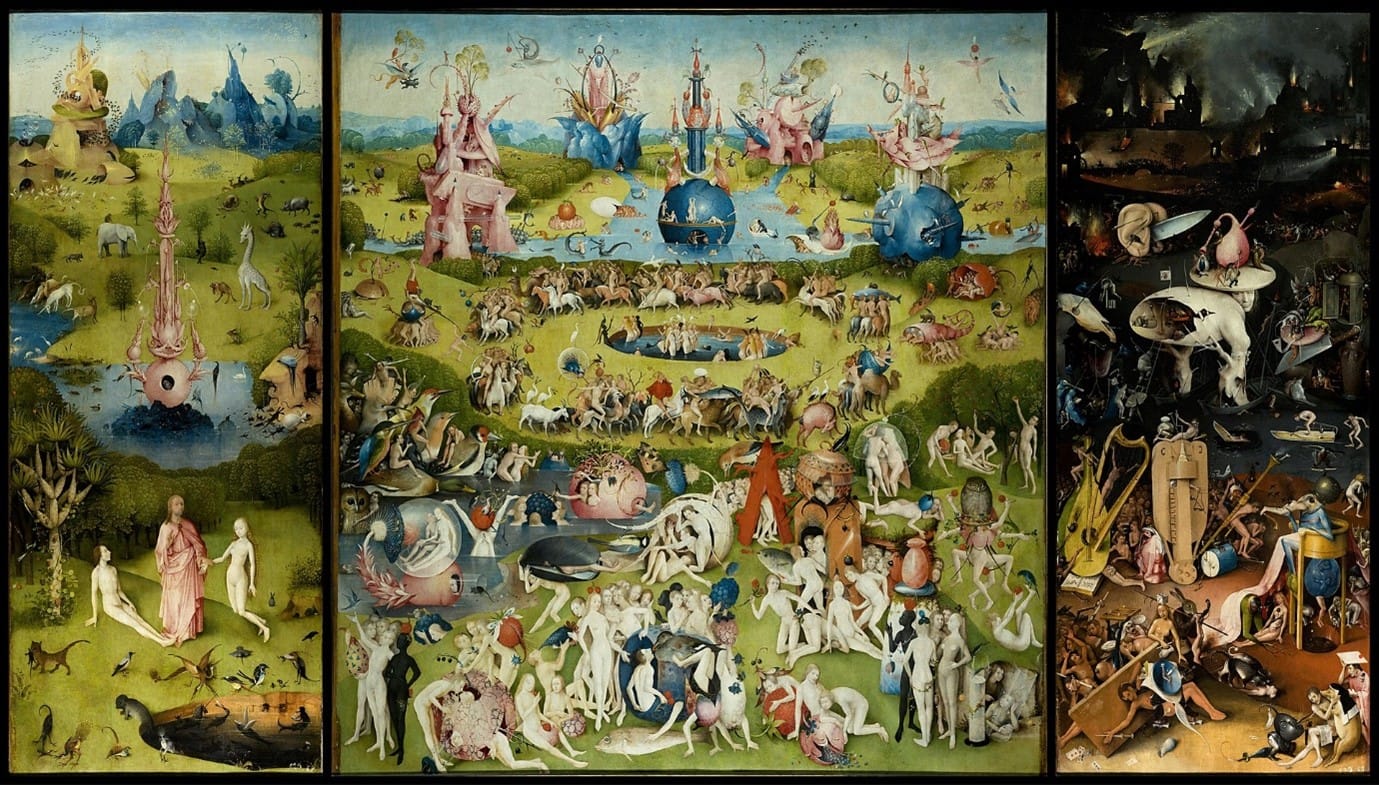
The Garden of Earthly Delights
Little is known about the painter Hieronymus Bosch, yet his distinctive style is recognizable even to many who are generally indifferent to fine art. But it’s also full of puzzles, and he left us no explanations. The painting known as The Garden of Earthly Delights is a case in point.
Also at the Museo del Prado in Madrid are Goya’s ‘black paintings’, and these works leave little doubt about the artist’s intentions; entering the room can feel like a wrong turn into a dark alley. Or for a yet more modern portrayal of human infamy, around the corner at the Museo Reina Sofía there’s Picasso’s Guernica, in which our painterly analogues, as if reflected to us in a mythic looking glass, cry up in anguish to a God who has turned away in a sky raining bombs.
Despite their content, we can enter these works and become part of the action in a way that is discouraged by Bosch’s Garden. Although Goya’s scenes are dreamlike, macabre, and frequently repellent, and Picasso’s gargantuan and misshapen, they are also instantly intelligible to the modern mind. Bosch, on the other hand, speaks to us through a veil, from a landscape vague and clouded. What did he mean to tell us?
By the turn of the Sixteenth Century, when The Garden was painted, Portugal’s innovative slave colony of Madeira had become Europe’s biggest sugar producer. Luca Pacioli had written the Summa de arithmetica, geometria , containing 27 pages about the double entry bookkeeping system, which would become the primary accounting textbook of the next century. It would be spread by another new device, the printing press, then in operation throughout Western Europe, which would also propagate the prototypical novel, Don Quixote by Miguel de Cervantes. But neither text would enjoy the enormous popularity of the demented phantasmagoria of the Malleus Maleficarum which presaged the murder of as many as 60,000 women as ‘witches’. Columbus was in the midst of four round-trip voyages which would relocate Spanish imperial ambitions to the Americas. Martin Luther would soon compose his Disputation on the Power and Efficacy of Indulgences, which precipitated the rift within Christendom we now call ‘the Reformation’, coinciding with an explosion of science, exploration, colonialism and mercantilism. And within a century, the first big joint-stock companies, The East India Company, originating in England, and the Dutch East India Company would be formed.
The Garden was the product of a culture about to disappear, where ordinary people rarely travelled very far from their places of birth, knew relatively few people throughout their lives, survived without literacy or numeracy, and for whom the great monument to human achievement was a cathedral punctuating the horizon, wherein, on some special occasion, they might behold in luminous stained glass a visual library of meaning and purpose, whose other-worldly priests conjured sacred profundity in a language they couldn’t understand.
The Garden is this kind of image. It’s a triptych. In the left panel, Adam and Eve are conjoined through their creator and saviour in a kind of elemental circuitry. In the middle panel, their numerous, ageless progeny cavort and socialise harmlessly among plants, animals and mythical creatures. This seems to be the world as it might have been, before a third panel shows our innocence sacrificed for the dark depravities soon to be documented by Goya and Picasso. Is it the medieval world looking back at the Old Testament? Or the ancient world looking forward with foreboding?
The Garden of Earthly Delights records a moment when the world fractured, a liminal place between ancient and modern ways of seeing, where, like the pieces of a broken vase attempting reassembly, we try to get our bearings, find some thread of continuity with our deep ancestry, some understanding which can accommodate the full extent of our cumulative experience, and orient ourselves to a possible future we might want to be in; a moment very like the present one.
[1] King James Bible, Corinthians 13:11.
[2] Burns, D. & Ward, M. (2025), “Military contractors pitch unprecedented prison plan for detained immigrants”, Politico, Apr 11.
[3] Smith, P. & Grumbach, G. (2025), “A man was sent to El Salvador due to 'administrative error' despite protected legal status, filings show”, NBC News, Apr 1.
[4] Corbett, J. (2025), “Columbia University Revokes Degrees From Some Pro-Palestine Campus Protesters”, Truthout, Mar 14.
[5] Kirenci, A. I. (2024), “How German police are terrorising children in pro-Palestine protests”, TRTWorld, Aug 26.
[6] Fox, K. (2024), “Climate protesters are taking action against Big Oil. UK courts are handing them prison terms akin to rapists and thieves”, CNN, Sep 14.
[7] Byrne, E. & Toomey, J. (2025), “Jailed whistleblower David McBride loses appeal against severity of sentence, flags High Court challenge”, ABCNews, May 28.
[8] Cameron, D. (2025), “The ‘Long-Term Danger’ of Trump Sending Troops to the LA Protests”, Wired, Jun 10.
[9] Dietrich L, Meister J, Dietrich O, Notroff J, Kiep J, Heeb J, Beuger A, Schütt B. Cereal processing at Early Neolithic Göbekli Tepe, southeastern Turkey. PLoS One. 2019 May 1;14(5):e0215214. doi: 10.1371/journal.pone.0215214. PMID: 31042741; PMCID: PMC6493732.
[10] Nigro, L. (2023). THE PLANTS OF JERICHO. THE EARLIEST CULTIVARS BETWEEN SYMBIOSIS AND DOMESTICATION. Annali Di Botanica, Vol. 13.
[11] Özdoğan, M. (2014). Çayönü: Agriculture and Domestication. In: Smith, C. (eds) Encyclopedia of Global Archaeology. Springer, New York, NY.
[12] Haldorsen, S.; et al. (2011). “The climate of the Younger Dryas as a boundary for Einkorn domestication”. Vegetation History and Archaeobotany. 20. 305.doi:10.1007/s00334-011-0291-5.
[13] Kirleis, W., Corso, M.D., Pashkevych, G. et al. A complex subsistence regime revealed for Cucuteni–Trypillia sites in Chalcolithic eastern Europe based on new and old macrobotanical data. Veget Hist Archaeobot 33, 75–90 (2024).
[14] Quinn, D. (1995), Ishmael, US, Random House.
[15] Meyer C, Knipper C, Nicklisch N, Münster A, Kürbis O, Dresely V, Meller H, Alt KW. Early Neolithic executions indicated by clustered cranial trauma in the mass grave of Halberstadt. Nat Commun. 2018 Jun 25;9(1):2472. doi: 10.1038/s41467-018-04773-w. PMID: 29941965; PMCID: PMC6018543.
[16] Strickland, A. (2024), “Thousands of bones and hundreds of weapons reveal grisly insights into a 3,250-year-old battle”, CNN, Sep 24.
[17] Breasted, James Henry. Ancient Records of Egypt: Historical Documents from the Earliest Times to the Persian Conquest Collected, Edited, and Translated with Commentary. London: Histories & Mysteries of Man, 1988.
[18] Roos, D. (2025), “What Caused the Bronze Age Collapse?”, history.com, Jan 31.
[19] Quiles, C. (2019), “Sea Peoples behind Philistines were Aegeans, including R1b-M269 lineages”, Indo-European.eu, Jul 4.
[20] Gardini, A. (2024), “Çatalhöyük: Its Story Continues”, JSTOR Daily, Dec 10.
[21] World Archeology (2016), “Lady of Çatalhöyük”, the-past.com, May 17.
[22] McGilchrist, I. (2009), The Master and His Emissary, US, Yale University Press.
[23] Miller McDonald, S (2025), Progress: How One Idea Built Civilization and Now Threatens to Destroy It, UK, St Martin’s Press.
[24] Heger, P. (2014). Interpretations of the Fall Narrative. In Women in the Bible, Qumran and Early Rabbinic Literature: Their Status and Roles (pp. 46–110). Brill. http://www.jstor.org/stable/10.1163/j.ctt1w76vnm.6
[25] Baden, J. (2021), “Famine in the Bible is more than a curse: It is a signal of change and a chance for a new beginning”, The Conversation, Apr 21.
[26] Girard, R. (1989), The Scapegoat, US, Johns Hopkins University Press.
[27] Foucault, M (1961), Madness and Civilisation, Fr, Librairie Plon.
[28] Foucault, M (1975), Discipline and Punish, Fr, Gallimard.